Symmetric formulations of the spanning-tree polytope
Sebastian Pokutta
v1 2026-10-22 · last 2026-10-29
Additional material: arXiv:2606.17017
Abstract. Finite Lean formalizations of bounds and concrete formulations for the spanning-tree polytope. The Hamilton-path LP lower bounds, including the exact factor-one and fixed-approximation-factor corollaries, retain an explicit small-index subgroup theorem as an unproved input. Independent results cover a symmetric LP with sharp approximation factor , its cardinality slice, exact quadratic-size SDP formulations with coordinate-permutation or orthogonal symmetry, ordered-root SDP constructions, and a sum-of-block-orders lower bound for nonnegative outer PSD formulations. Approximation means maximization with nonnegative objectives; PSD size means the sum of block orders.
This entry gives finite theorem statements and Lean formalizations accompanying Sebastian Pokutta’s “(Approximate) Symmetric Extension Complexity of the Spanning Tree Polytope” Pokutta, 2026. See the paper for proofs. The lower-bound argument used here is the Hamilton-path construction; the exact LP lower bound is its factor-one corollary.
Scope of the lower bounds. The LP lower bounds assume the small-index group theorem stated below. That input is explicit in Lean and is not proved in this entry. The LP upper formulation, the exact SDP constructions, and the nonnegative-outer PSD lower bound do not use it.
Paper correspondence (arXiv v2). The finite LP lower bounds come from Theorem 5.7; the exact corollary gives the lower-bound part of Theorem 1.1 by the Hamilton route. The concrete LP is Proposition 5.4, with sharpness refinements stated below. The SDP constructions correspond to Theorem 6.2, Corollary 6.3, and Theorem 6.4; the nonnegative-outer bound corresponds to Proposition 6.7. Only the finite statements displayed here are exported, not the paper’s asymptotic extension-complexity claims.
1Models
An LP presentation has an auxiliary real vector space, an affine subspace , affine inequalities , and an affine projection . Its image is . Equations are free; counts the displayed inequalities, including redundant ones. Symmetry means a group homomorphism from to affine automorphisms of the auxiliary space that preserve the feasible set and make equivariant there. The normal-form proof does not require boundedness, full dimension, or a supplied permutation of rows.
Approximation throughout means maximization with nonnegative objectives, not minimum spanning tree approximation. For , contains every and satisfies
PSD size is the sum of block orders, not the number of matrix entries. A scalar inequality is an order-one PSD block; affine equations are free. An exact single-cone formulation of order is an affine slice of with a linear projection whose image equals .
Lean indexes vectors by Sym2 (Fin n), including diagonal pairs. Tree incidences
are zero on those pairs. EdgeCoordinates proves the zero-padding/restriction,
objective, symmetry, and formulation transports from ordinary loopless edges,
without adding LP rows or PSD blocks. PSD slices are written in all real
matrices; positive semidefiniteness itself enforces symmetry.
The actual tree type and unique-path/parent infrastructure are reused from
the full-slack factorization entry.
2Hamilton-path LP lower bounds
The explicit input SmallIndexK3Criterion is the following group-theoretic
statement: for , every subgroup with
contains for some .
Here consists of the even permutations fixing pointwise.
The following three statements are conditional on this input.
Exactness supplies approximation factor 1, and in this range. Thus no separate finite-gadget proof is needed for this corollary.
2.1The construction
For the construction take and fix the distinguished vertex labels . An ordering defines an actual Hamilton path by joining consecutive labels, and a set of distinguished positions . On the auxiliary cycle of positions, put
These are signed ordering weights, not probabilities. The figure uses one-based
labels and positions; Lean uses Fin n and the inverse permutation, sending
labels to positions.
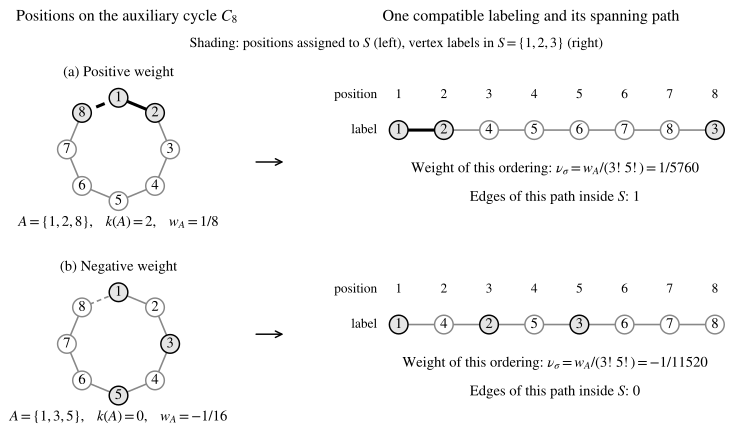
Figure 1:The Hamilton-path construction from the paper. The auxiliary cycle includes the dashed closing pair of positions, but the path has no closing edge. In the first example the cycle count is two while the path has only one edge inside the triangle of distinguished labels. Reverse orderings give the same undirected path, so their weights are added. These examples illustrate the construction, not the lower-bound theorem.
3A quadratic-size LP at the threshold
The concrete orientation LP uses variables , with
and projection . Vertex permutations act by simultaneous row and column reindexing.
4Exact quadratic-size semidefinite formulations
The following constructions use a single PSD cone, with no extra scalar inequality blocks or rank constraints. Exactness and symmetry refer to the same affine slice and projection.
The compressed action is not asserted to permute coordinates.
At , these four orders are respectively . The formulas with subtraction are not being extrapolated to .
5A lower bound for nonnegative outer PSD formulations
The nonnegative-image hypothesis is essential to this statement; it is not being silently dropped for arbitrary outer relaxations.
6Lean statements
SymmetricLP bundles the actual affine presentation and its coherent symmetry.
HasPermutationPSD and HasOrthogonalPSD bundle the exact formulation, its order,
and the corresponding action on that same formulation. PSDPresentation allows
an arbitrary auxiliary space and a finite family of PSD blocks.
section LinearLowerBounds
variable {n : ℕ} {E J : Type*} [AddCommGroup E] [Module ℝ E] [Fintype J]

/-- Conditional Hamilton-path threshold for every finite affine-symmetric LP. -/
theorem hamilton_threshold (smallIndex : SmallIndexK3Criterion) (hn : 13 ≤ n)
    (L : SymmetricLP n E J) (hrows : Fintype.card J < n.choose 3)
    (β : ℝ) (happrox : L.Approximates β) :
    (3 / 2 : ℝ) * (1 - 1 / (n : ℝ)) ≤ β :=
  PolyhedralNormalForm.affine_lp_factor_lower L.slice L.slack L.project L.action
    L.stable L.covariant smallIndex hn hrows β
    ((L.approximates_iff_source β).mp happrox)

/-- Exactness supplies factor one; this proof uses no separate K6 certificate. -/
theorem exact_lp_lower (smallIndex : SmallIndexK3Criterion) (hn : 13 ≤ n)
    (L : SymmetricLP n E J) (hexact : L.Exact) : n.choose 3 ≤ Fintype.card J := by
  apply LPResults.exact_size_lower L.slice L.slack L.project L.action
    L.stable L.covariant smallIndex hn
  exact hexact.trans (treePolytope_eq_source n)

/-- Finite sufficiently-large-n form for every fixed factor below 3/2. -/
theorem fixed_factor_lp_lower (smallIndex : SmallIndexK3Criterion) (hn : 13 ≤ n)
    (L : SymmetricLP n E J) (β : ℝ) (hβ : β < 3 / 2)
    (hlarge : 3 / (3 - 2 * β) < (n : ℝ)) (happrox : L.Approximates β) :
    n.choose 3 ≤ Fintype.card J :=
  PolyhedralNormalForm.affine_lp_size_lower_of_fixed_factor
    L.slice L.slack L.project L.action L.stable L.covariant smallIndex hn β hβ hlarge
    ((L.approximates_iff_source β).mp happrox)
end LinearLowerBounds

/-- Literal row count, symmetry and sharp approximation factor of one concrete LP. -/
theorem symmetric_lp_upper (n : ℕ) (hn : 3 ≤ n) :
    Fintype.card (FormulationStructure.ScalarConstraint (Fin n)) =
      3 * n.choose 2 + n ∧
    (orientationLP n).Approximates (3 / 2 : ℝ) ∧
    ∀ β, (orientationLP n).Approximates β → (3 / 2 : ℝ) ≤ β :=
  ⟨orientationLP_count n, orientationLP_factor n hn⟩

/-- Intersecting the concrete image with the tree-cardinality hyperplane does
not improve its worst-case approximation factor once n ≥ 4. -/
theorem cardinality_slice_factor (n : ℕ) (hn : 4 ≤ n) :
    Approximation.MaxApproximation (SpanningTreeMinSplit.edgeValue (n := n))
      (ApproximationSharpness.cardinalitySlice (orientationLP n).image) (3 / 2 : ℝ) ∧
    ∀ β, Approximation.MaxApproximation (SpanningTreeMinSplit.edgeValue (n := n))
      (ApproximationSharpness.cardinalitySlice (orientationLP n).image) β →
      (3 / 2 : ℝ) ≤ β := by
  have h : SpanningTreeMinSplit.edgeValue (n := n) =
      ApproximationUpper.treeIncidence (V := Fin n) := funext incidence_eq_source
  simpa only [h, orientationLP_image] using
    FormulationTransport.lp_fin_cardinality_exact_factor n hn

/-- One cone of order 3m, with a coherent coordinate-permutation action. -/
theorem symmetric_raw_sdp (n : ℕ) (hn : 2 ≤ n) :
    HasPermutationPSD n (3 * n.choose 2) := by
  let : NeZero n := ⟨by omega⟩
  unfold HasPermutationPSD
  rw [treePolytope_eq_source]
  let F := SDPResults.symmetricRawModel (V := Fin n)
  exact ⟨_, inferInstance, inferInstance, F.formulation,
    by simpa using F.order_eq, ⟨F.symmetry⟩⟩

/-- One cone of order 3m-n, with a coherent orthogonal-congruence action. -/
theorem symmetric_compressed_sdp (n : ℕ) (hn : 2 ≤ n) :
    HasOrthogonalPSD n (3 * n.choose 2 - n) := by
  let : NeZero n := ⟨by omega⟩
  let : Nontrivial (Fin n) := Fin.nontrivial_iff_two_le.mpr hn
  unfold HasOrthogonalPSD
  rw [treePolytope_eq_source]
  let F := SDPResults.symmetricCompressedModel (V := Fin n)
  exact ⟨_, inferInstance, inferInstance, F.formulation,
    by simpa using F.order_eq, ⟨F.symmetry⟩⟩

/-- The ordered-root constructions: existence, with no symmetry requirement. -/
theorem ordered_sdps (n : ℕ) (hn : 2 ≤ n) :
    HasExactPSD n (2 * n.choose 2) ∧ HasExactPSD n (2 * n.choose 2 - 1) := by
  let : NeZero n := ⟨by omega⟩
  let : Nontrivial (Fin n) := Fin.nontrivial_iff_two_le.mpr hn
  constructor
  · unfold HasExactPSD
    rw [treePolytope_eq_source]
    have h := SDPResults.ordered_raw (V := Fin n)
    exact ⟨_, inferInstance, by simpa using h.2, h.1⟩
  · unfold HasExactPSD
    rw [treePolytope_eq_source]
    have h := SDPResults.ordered_compressed (V := Fin n)
    exact ⟨_, inferInstance, by simpa using h.2, h.1⟩

/-- Direct product-PSD lower bound: nonnegative image is essential; symmetry is not. -/
theorem nonnegative_outer_psd_lower {n : ℕ} (hn : 2 ≤ n)
    {E B : Type*} {K : B → Type*} [AddCommGroup E] [Module ℝ E]
    [Fintype B] [∀ b, Fintype (K b)] (L : PSDPresentation n E B K)
    (hcontains : treePolytope n ⊆ L.image)
    (hnonneg : ∀ x ∈ L.image, ∀ e, 0 ≤ x e) :
    (n - 1).choose 2 ≤ ∑ b, Fintype.card (K b) := by
  let : NeZero n := ⟨by omega⟩
  have h := NonnegativeOuter.sdp_size_lower_of_polytope_containment
    L.slice L.block L.project (by rwa [← treePolytope_eq_source]) hnonneg
  simpa using h
The source separates the Hamilton certificate, affine normal form, concrete LP, quadratic Gram constructions, and direct product-PSD lower bound into supporting modules. It does not formalize the small-index input, a minimum-extension-size operator, or separate asymptotic/optimality claims.
Formal verification — ✅ all 10 formal results are kernel-checked
◇ elaborated definition (Lean v4.35.0) Definition 1 —
Lemmata.SpanningTreeSymmetricEF.treePolytope(source)✓ kernel-checked (Lean v4.35.0) Theorem 1 —
Lemmata.SpanningTreeSymmetricEF.hamilton_threshold(source)✓ kernel-checked (Lean v4.35.0) Corollary 1 —
Lemmata.SpanningTreeSymmetricEF.exact_lp_lower(source)✓ kernel-checked (Lean v4.35.0) Corollary 2 —
Lemmata.SpanningTreeSymmetricEF.fixed_factor_lp_lower(source)✓ kernel-checked (Lean v4.35.0) Theorem 2 —
Lemmata.SpanningTreeSymmetricEF.symmetric_lp_upper(source)✓ kernel-checked (Lean v4.35.0) Corollary 3 —
Lemmata.SpanningTreeSymmetricEF.cardinality_slice_factor(source)✓ kernel-checked (Lean v4.35.0) Theorem 3 —
Lemmata.SpanningTreeSymmetricEF.symmetric_raw_sdp(source)✓ kernel-checked (Lean v4.35.0) Theorem 4 —
Lemmata.SpanningTreeSymmetricEF.symmetric_compressed_sdp(source)✓ kernel-checked (Lean v4.35.0) Theorem 5 —
Lemmata.SpanningTreeSymmetricEF.ordered_sdps(source)✓ kernel-checked (Lean v4.35.0) Theorem 6 —
Lemmata.SpanningTreeSymmetricEF.nonnegative_outer_psd_lower(source)
Checked at commit a20ff2d299b3. The formal statement is machine-checked; that it matches the prose is checked by review. What “checked” means.
Lean treePolytope · ◇ elaborated · source
Definition in Lean
/-- The actual spanning-tree polytope, embedded with zero diagonal coordinates. -/
def treePolytope (n : ℕ) : Set (Sym2 (Fin n) → ℝ) :=
  convexHull ℝ (Set.range (SpanningTreeMinSplit.edgeValue (n := n)))
Lean hamilton_threshold · ✅ kernel-checked · source
Statement in Lean
/-- Conditional Hamilton-path threshold for every finite affine-symmetric LP. -/
theorem hamilton_threshold (smallIndex : SmallIndexK3Criterion) (hn : 13 ≤ n)
    (L : SymmetricLP n E J) (hrows : Fintype.card J < n.choose 3)
    (β : ℝ) (happrox : L.Approximates β) :
    (3 / 2 : ℝ) * (1 - 1 / (n : ℝ)) ≤ β
Lean exact_lp_lower · ✅ kernel-checked · source
Statement in Lean
/-- Exactness supplies factor one; this proof uses no separate K6 certificate. -/
theorem exact_lp_lower (smallIndex : SmallIndexK3Criterion) (hn : 13 ≤ n)
    (L : SymmetricLP n E J) (hexact : L.Exact) : n.choose 3 ≤ Fintype.card J
Lean fixed_factor_lp_lower · ✅ kernel-checked · source
Statement in Lean
/-- Finite sufficiently-large-n form for every fixed factor below 3/2. -/
theorem fixed_factor_lp_lower (smallIndex : SmallIndexK3Criterion) (hn : 13 ≤ n)
    (L : SymmetricLP n E J) (β : ℝ) (hβ : β < 3 / 2)
    (hlarge : 3 / (3 - 2 * β) < (n : ℝ)) (happrox : L.Approximates β) :
    n.choose 3 ≤ Fintype.card J
Lean symmetric_lp_upper · ✅ kernel-checked · source
Statement in Lean
/-- Literal row count, symmetry and sharp approximation factor of one concrete LP. -/
theorem symmetric_lp_upper (n : ℕ) (hn : 3 ≤ n) :
    Fintype.card (FormulationStructure.ScalarConstraint (Fin n)) =
      3 * n.choose 2 + n ∧
    (orientationLP n).Approximates (3 / 2 : ℝ) ∧
    ∀ β, (orientationLP n).Approximates β → (3 / 2 : ℝ) ≤ β
Lean cardinality_slice_factor · ✅ kernel-checked · source
Statement in Lean
/-- Intersecting the concrete image with the tree-cardinality hyperplane does
not improve its worst-case approximation factor once n ≥ 4. -/
theorem cardinality_slice_factor (n : ℕ) (hn : 4 ≤ n) :
    Approximation.MaxApproximation (SpanningTreeMinSplit.edgeValue (n := n))
      (ApproximationSharpness.cardinalitySlice (orientationLP n).image) (3 / 2 : ℝ) ∧
    ∀ β, Approximation.MaxApproximation (SpanningTreeMinSplit.edgeValue (n := n))
      (ApproximationSharpness.cardinalitySlice (orientationLP n).image) β →
      (3 / 2 : ℝ) ≤ β
Lean symmetric_raw_sdp · ✅ kernel-checked · source
Statement in Lean
/-- One cone of order 3m, with a coherent coordinate-permutation action. -/
theorem symmetric_raw_sdp (n : ℕ) (hn : 2 ≤ n) :
    HasPermutationPSD n (3 * n.choose 2)
Lean symmetric_compressed_sdp · ✅ kernel-checked · source
Statement in Lean
/-- One cone of order 3m-n, with a coherent orthogonal-congruence action. -/
theorem symmetric_compressed_sdp (n : ℕ) (hn : 2 ≤ n) :
    HasOrthogonalPSD n (3 * n.choose 2 - n)
Lean ordered_sdps · ✅ kernel-checked · source
Statement in Lean
/-- The ordered-root constructions: existence, with no symmetry requirement. -/
theorem ordered_sdps (n : ℕ) (hn : 2 ≤ n) :
    HasExactPSD n (2 * n.choose 2) ∧ HasExactPSD n (2 * n.choose 2 - 1)
Lean nonnegative_outer_psd_lower · ✅ kernel-checked · source
Statement in Lean
/-- Direct product-PSD lower bound: nonnegative image is essential; symmetry is not. -/
theorem nonnegative_outer_psd_lower {n : ℕ} (hn : 2 ≤ n)
    {E B : Type*} {K : B → Type*} [AddCommGroup E] [Module ℝ E]
    [Fintype B] [∀ b, Fintype (K b)] (L : PSDPresentation n E B K)
    (hcontains : treePolytope n ⊆ L.image)
    (hnonneg : ∀ x ∈ L.image, ∀ e, 0 ≤ x e) :
    (n - 1).choose 2 ≤ ∑ b, Fintype.card (K b)
Acknowledgements. The author would like to thank Kanstantsin Pashkovich and Christoph Hertrich for the recent discussions on extended formulations that prompted the author to revisit the question as well as Gábor Braun for comments on an earlier draft. Research reported in this paper was partially supported by the Berlin Mathematics Research Center MATH (EXC-2046/2, project ID 390685689), funded by the Deutsche Forschungsgemeinschaft (DFG, German Research Foundation) under Germany’s Excellence Strategy. This work has been partially supported by OpenAI’s Academic Researchers program.
License: CC BY 4.0
Comments.
- Pokutta, S. (2026). (Approximate) Symmetric Extension Complexity of the Spanning Tree Polytope. 10.48550/arXiv.2606.17017